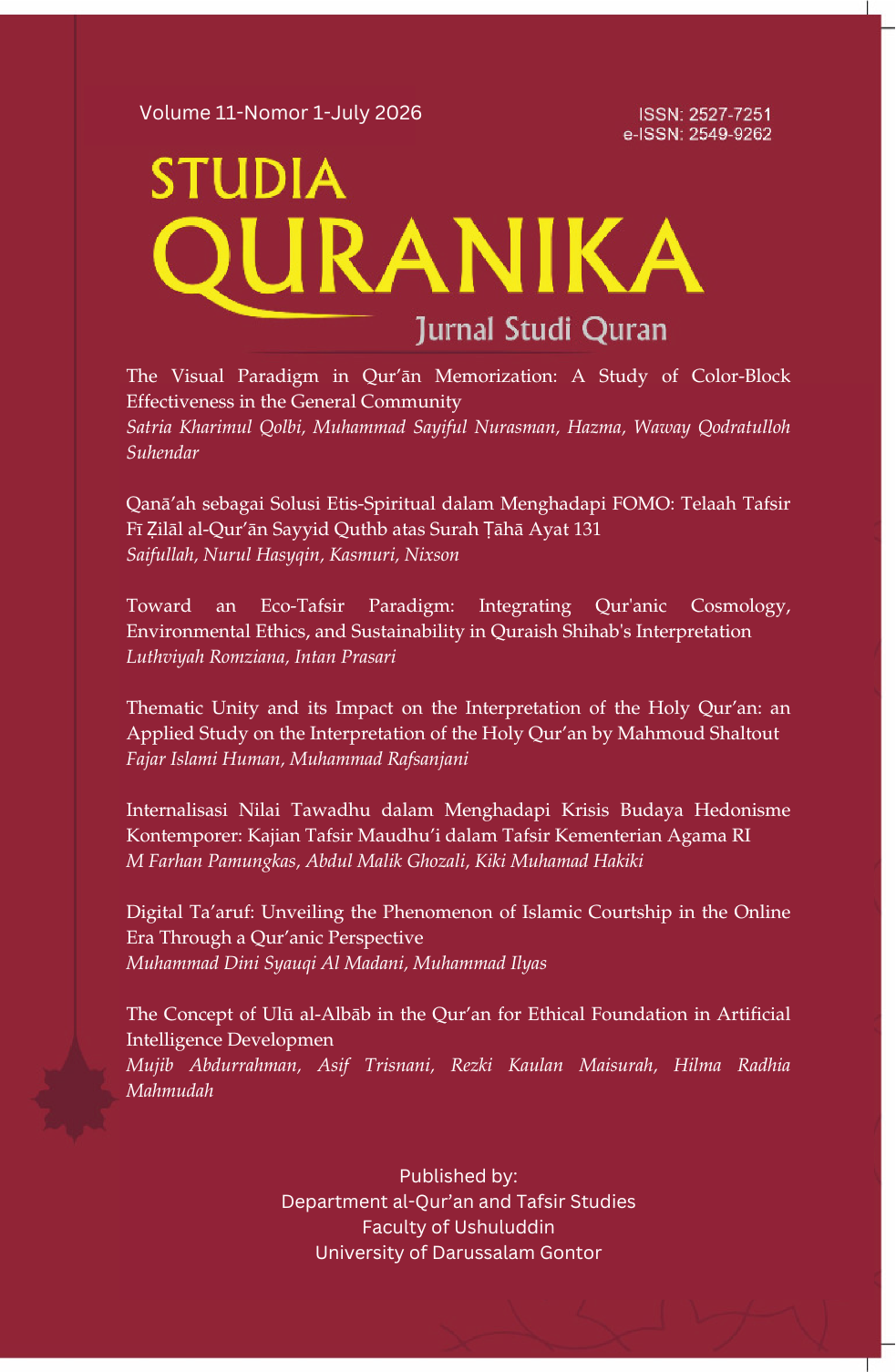
Qanā’ah sebagai Solusi Etis-Spiritual dalam Menghadapi FOMO: Telaah Tafsir Fī Ẓilāl al-Qur’ān Sayyid Quthb atas Surah Ṭāhā Ayat 131
DOI:
https://doi.org/10.21111/studiaquranika.v11i1.32Keywords:
Qanā’ah, FOMO, Fī Ẓilāl al-Qur’ān, Surah Ṭāhā ayat 131Abstract
This study explores Sayyid Quthb's interpretation of contentment in Surah Ṭāhā verse 131 through the interpretation of Fī Ẓilāl al-Qur’ān, while also revealing its relevance as a moral basis for dealing with the phenomenon of Fear of Missing Out (FOMO) in the digital age, namely the era of socio-cultural transformation marked by the massive penetration of digital technology into all aspects of human life including how to interact, communicate, and construct self-identity through social media. The main focus needs to be directed at the role of contentment. This attitude is a spiritual remedy for social anxiety triggered by the habit of comparing oneself on social media. The study adopts a descriptive-analytical approach based on literature study. The main data comes from the text of the Qur'an Surah Ṭāhā (20): 131. To strengthen the analysis, this study not only refers to Sayyid Quthb's thoughts in Fī Ẓilāl al-Qur’ān, but also attempts to dialogue with various other tafsir books. The main contribution of this study lies in exploring the relevance of Sayyid Qutb’s thoughts in Fī Ẓilāl al-Qur’ān to address contemporary mental issues, particularly the phenomenon of FOMO. By making the concept of qanā’ah as a meeting point, this study attempts to open a space for dialogue between Sayyid Qutb’s interpretation and the spiritual needs of digital society, while acknowledging that enrichment from various other interpretive perspectives is still very necessary for a more comprehensive understanding
References
Abdul Halim. (2022). Konsep spiritual quotient dalam Tafsir Fî Zhilâlil Qur’ân karya Sayyid Quthb dan implikasinya terhadap pendidikan Islam. Tesis Magister, Universitas Islam Negeri Sultan Syarif Kasim Riau.
Abdusshomad, A. (2020). Penerapan sifat qanaah dalam mengendalikan hawa nafsu duniawi. Jurnal Asy-Syukriyyah, 21, 21–33. https://doi.org/10.36769/asy.v21i1.95
Ahlava, A. (2002). Architecture in consumer society. Doctoral dissertation, University of Art and Design Helsinki. Publication series of the University of Art and Design Helsinki, A 36.
Ahmad, S. S., Sa’ari, C. Z., & Mohd Azhar, M. H. (2025). Pendekatan psikospiritual Islam dalam meredakan keresahan FOMO (Fear of Missing Out) warga emas di era digital. Al-Basirah Journal, 15(2), 1–12. https://doi.org/10.22452/basirah.vol15no2.1
Akhwati Dwi Nurjannah. (2023). Kebahagiaan dalam perspektif Al-Qur’an [Skripsi Sarjana, Universitas PTIQ Jakarta].
Al-Ghazali, A. H. M. b. M. (2001). Iḥyā’ ‘ulūm al-dīn (Juz 3). Maktabah wa Maṭba’ah Muḥammad ‘Alī Ṣubaiḥ wa Aulāduh.
Ali Syariati. (2020). Bab III pembahasan: Konsep Islam revolusi dalam pemikiran Ali Syariati
Alter, A. (2018). Review of the book Irresistible: The rise of addictive technology and the business of keeping us hooked. Journal of Information Policy, 8, 314–317. https://doi.org/10.5325/jinfopoli.8.2018.0314
Amalia Azlikah, N. (2025). Qanā’ah dalam Al-Qur’an (Studi komparatif Tafsir Al-Azhar dan Tafsir Al-Mishbah). Jurnal Riset Multidisiplin Edukasi, 2, 244–259. https://doi.org/10.71282/jurmie.v2i2.153
Amir, A. N., Abdul, T., & Fakulti, R. (2025). Sayyid Qutb: Prinsip dan idealisme gerakan. Al-Mujaddid: Jurnal Ilmu-Ilmu Agama, 7(1), 1–15. https://doi.org/10.51482/almujaddid.v7i1.119
Aniroh, R. N. (2016). Ta’wil Muḥammad Syahrūr atas Al-Qur’ān Tesis Magister, Universitas Islam Negeri Sunan Kalijaga.
Anusuya, S., & Gayatridevi, S. (2025). Acceptance and commitment therapy and psychological well-being: A narrative review. Cureus. https://doi.org/10.7759/cureus.77705
Arinie, S. (2025). Peran konsumsi konten religius di media sosial terhadap kesejahteraan psikologis mahasiswa IAIN Palangkaraya. Jinu, 2(4), 785–797. https://doi.org/10.61722/jinu.v2i4.5189
Calvert, J. (2010). Sayyid Qutb and the origins of radical Islamism. Columbia University Press.
Citra Ramadhanty. (2023). Implementasi qanā’ah terhadap rasa rendah diri (inferiority). Nathiqiyyah, 6(1), 26–33. https://doi.org/10.46781/nathiqiyyah.v6i1.743
David, M. E., Roberts, J. A., & Christenson, B. (2018). Too much of a good thing: Investigating the association between actual smartphone use and individual well-being. International Journal of Human-Computer Interaction, 34(3), 265–275. https://doi.org/10.1080/10447318.2017.1349250
Dewi, K., & Hidayat, R. (2024). Konsep kebahagiaan perspektif Islam dalam Al-Qurán. Jurnal Ilmiah Pendidikan Islam, 1(4). https://doi.org/10.61132/ikhlas.v1i4.106
Fadhillah, W., Isnaeni, Y., & Salmiyati. (2024). Pengaruh dzikir terhadap ketenangan jiwa pada lansia di UPT Rumah Pelayanan Sosial Lanjut Usia Terlantar Budhi Dharma Yogyakarta. In Prosiding Seminar Nasional Penelitian dan Pengabdian Kepada Masyarakat LPPM Universitas' Aisyiyah Yogyakarta (Vol. 2, pp. 1431-1434). https://proceeding.unisayogya.ac.id/index.php/prosemnaslppm/article/view/485
Faishal Aushafi. (2017). Pengaruh dzikir terhadap ketenangan jiwa pedagang Pasar Johar pasca kebakaran Skripsi Sarjana, Universitas Islam Negeri Walisongo.
Farid Ali, M. (2018). Contentment (qanāʿah) and its role in curbing social and environmental problems. ICR Journal 5(3):430-445. https://doi.org/10.52282/icr.v5i3.391
Five tracts of Hasan Al-Banna (1906-1949). (2004).
Furqan, A., Alfi Zahrotus Shiyami, M. A. Z. S., Ashar, S., & Masrury, F. (2024). Psikologi fear of missing out dalam Al-Qur’an. Jurnal Agama, Sosial, dan Budaya, 3(4). https://publisherqu.com/index.php/
Haggart, B. (2019). [Review of the book The age of surveillance capitalism: The fight for a human future at the new frontier of power, by S. Zuboff]. Journal of Digital Media & Policy, 10(2), 229–243. https://doi.org/10.1386/jdmp.10.2.229_5
Hamali, S. (2018). Kepribadian dalam teori Sigmound Freud dan nafsiologi dalam Islam. Al-Adyan: Jurnal Studi Lintas Agama, 13(2), 285–302. https://doi.org/10.24042/ajsla.v13i2.3844
Heriyanto, et al., (2017). Melawan hoax di media sosial dan media massa. Trust Media Publishing.
Hj Ab Rahman, A., Ali, N., & Ibrahim Wan Ahmad, W. (2011). The influence of al-‘Aqqad and the Diwan school of poetry on Sayyid Qutb’s writings. International Journal of Humanities and Social Science, 1(8). http://www.ijhssnet.com
Hogan, B. (2010). The presentation of self in the age of social media: Distinguishing performances and exhibitions online. Bulletin of Science, Technology & Society, 30(6), 377–386. https://doi.org/10.1177/0270467610385893
Hu, X., Kim, A., Siwek, N., & Wilder, D. (2017). The Facebook paradox: Effects of Facebooking on individuals’ social relationships and psychological well-being. Frontiers in Psychology, 8(Jan). https://doi.org/10.3389/fpsyang.2017.00087
Ihwanuddin. (2017). Pendidikan akhlak dalam Al Qur’an Surat An Naba’ ayat 31-38: Telaah Tafsir Al Misbah karya Muhammad Quraish Shihab Skripsi Sarjana, UIN Raden Intan Lampung.
Katsir, Ibnu, Tafsir Al-Qur’an Al-‘Azim, Juz 5, Riyadh: Dar Ṭayyibah,
Loboda, L. (2004). The thought of Sayyid Qutb. Ashbrook Statesmanship Thesis, Ashland University.
Lustig, C., Pine, K., Nardi, B., Irani, L., Lee, M. K., Nafus, D., & Sandvig, C. (2016). Algorithmic authority: The ethics, politics, and economics of algorithms that interpret, decide, and manage. Proceedings of the 2016 CHI Conference Extended Abstracts on Human Factors in Computing Systems, 1057–1062. https://doi.org/10.1145/2851581.2886426
Malikhatul Kamalia, Halimatussa’diyah, & Anggi Wahyu Ari. (2022). Makna qanā’ah dan implementasinya di masa kini (Kajian tafsir tahlili Qs. Al-Hajj, 22: 36). Jurnal Ilmu Al-Qur’an, Tafsir dan Pemikiran Islam, 3(1). https://doi.org/10.58401/takwiluna.v3i1.631
Menaldo, M. A. (2014). Sayyid Qutb’s political and religious thought: The transformation of jahiliyyah and the implications for Egyptian democracy. https://doi.org/10.4337/lath.2014.01.05
Muchlis Muhammad Hanaf (Ed.). (2019). Alquran dan terjemahannya edisi penyempurnaan. Lajnah Pentashihan Mushaf Al-Qur’an, Kementerian Agama RI.
Muhammad Arwani Rofi’i. (2020). Bahagia menurut Al-Qur’an. Al-I’jaz, 2(2), 1–27. https://doi.org/10.53563/ai.v2i2.41
Muhammad Fachri Fannany. (2023). Makna rezeki dalam Tafsir Al-Kasysyāf ‘an Haqāiq al-Tānzil wa ‘Uyūn al-Aqāwīl fī Wujūh al-Ta’wīl Skripsi Sarjana, Universitas Islam Negeri Sunan Kalijaga.
Noer, L. R., Prihananto, P., Asokawati, A., Ninglasari, Y., Gusti, N., & Rai, M. (2024). Pengaruh fear of missing out (FoMO) dan social media marketing terhadap niat pembelian pada produk healthy. Jurnal Sosial Humaniora (JSH), 17(1). http://creativecommons.org/licenses/by/4.0/
Nurul Hasyiqin. (2026). Qanā’ah sebagai kerangka etis menghadapi FoMO: Analisis Surah Ṭāhā ayat 131 perspektif Sayyid Quthb Skripsi Sarjana, Universitas Islam Negeri Sultan Syarif Kasim Riau.
Nurwathani, N., & Khumaero, K. (2023). Konsep wasathiyyah menurut Sayyid Quthb dalam kitab tafsir Fi Zhilal Al-Qur’an (Analisa sosiologi pengetahuan Peter Ludwig Berger). Jurnal Semiotika-Q: Kajian Ilmu Al-Qur’an dan Tafsir, 3(1). https://doi.org/10.19109/jsq.v3i1.18328
Primack, B. A., Shensa, A., Sidani, J. E., Whaite, E. O., Lin, L. Y., Rosen, D., Colditz, J. B., Radovic, A., & Miller, E. (2017). Social media use and perceived social isolation among young adults in the U.S. American Journal of Preventive Medicine, 53(1), 1–8. https://doi.org/10.1016/j.amepre.2017.01.010
Putra, J. S. (2018). Peran syukur sebagai moderator pengaruh perbandingan sosial terhadap self-esteem pada remaja pengguna media sosial. Psikohumaniora: Jurnal Penelitian Psikologi, 3(2), 197–210. https://doi.org/10.21580/pjpp.v3i2.2650
Quraish Shihab, M. (1996). Wawasan Al-Qur’an: Tafsir maudhu’i atas pelbagai persoalan umat. Mizan.
Qurtubhi, Al, Al-Jami’ Li Al-Ahkam Al-Qur’an, Juz 11, Beirut Dar Al-Kutub Al-Ilmiyyah.
Quthb, Sayyid, (2004) Fii Zhilalil Qur'an (Tafsir di Bawah Naungan Al-Qur'an), Jilid 8, Jakarta: Gema Insani Press.
Rahmadini. (2022). Corak jihad dalam Tafsir Fi Zhilal Al-Qur’an Skripsi Sarjana, Universitas Islam Negeri Sultan Syarif Kasim Riau.
Ramdani, R., Ghifari, M., & Ash, A. (2024). Fenomena fear of missing out (FoMO) di media sosial perspektif hadis. El-Afkar, 13(1). http://dx.doi.org/10.29300/jpkth.v13i1.3837
Razi Muhamad. (2024). Maintaining the mental health of Muslims in the digital era: Between FoMO and qanā’ah from the perspective of Ibnu Qayyim. Jurnal Psikologi dan Psikologi Islam. https://doi.org/xxxxxxx/psi.v17i2.10484
Riadi, S., Wahab, A., & Lestari, C. (2025). FoMO in the perspective of the Qur’an. Tanzil: Jurnal Studi Al-Quran, 8(1), 121–134. https://doi.org/10.20871/tjsq.v8i1.469
Roffarello, A. M., & De Russis, L. (2023). Achieving digital wellbeing through digital self-control tools: A systematic review and meta-analysis. ACM Transactions on Computer-Human Interaction, 30(4), 1–66. https://doi.org/10.1145/3571810
Siti Miftahul Lukluil Karimah. (2018). Kamus Al-Munawwir Arab-Indonesia (Sejarah penulisan dan perkembangannya tahun 1957-2018) Skripsi Sarjana, UIN Sunan Kalijaga.
Sitirokiyoh Pasengcheming. (2018). Makna jihad dalam Tafsir Fȋ Zhilâl Al-Qur’an dalam konteks jihad di Negara Patani Skripsi Sarjana, Universitas Islam Negeri Raden Intan Lampung.
Suryadinata, S. (2020). Penafsiran kata syaythan menurut Dawam Rahardjo dalam Ensiklopedi Al-Qur’an. Jurnal Sosial dan Budaya, 2(1). http://ecampus.iainbatusangkar.ac.id/ojs/index.php/istinarah/index
Suyuthi Al, (1983) Lubab An-Nuqul fī Asbab An-Nuzul, Beirut: Dar Iḥya’ Al ‘Ulum,.
Syarur, Mohammad, dkk. Studi Al-Qur’an Kontemporer; Wacana Baru Berbagai Metodologi Tafsir, Yogyakarta: Tiara Wacana, 2002.
Abdul, W. (2015). Konsep orang tua dalam membangun Kepribadian Anak. Jurnal Paradigma, 1(1).
Vidal, C., Lhaksampa, T., Miller, L., & Platt, R. (2020). Social media use and depression in adolescents: A scoping review. International Review of Psychiatry, 32(3), 235–253. https://doi.org/10.1080/09540261.2020.1720623
Wahidi, Al, (1999Asbabun Nuzul Al-Qurʾan, Beirut: Dar Al-Kutub Al Ilmiyah.
Wu, T. (2017). Review of the book The attention merchants: The epic scramble to get inside our heads, by T. Wu. Journal of Information Policy, 7, 268–271. https://doi.org/10.5325/jinfopoli.7.2017.0268
Yongbao, W. (2024). The impact of colonialism and nationalism on the marginalization of Islamic law in the Muslim world. Malaysian Journal of Syariah and Law, 12(2), 375–387. https://doi.org/10.33102/mjsl.vol12no2.653
Downloads
Submitted
Accepted
Published
How to Cite
Issue
Section
License
Copyright (c) 2026 Saifullah, Nurul Hasyqin, Kasmuri, Nixson

This work is licensed under a Creative Commons Attribution-NonCommercial-ShareAlike 4.0 International License.