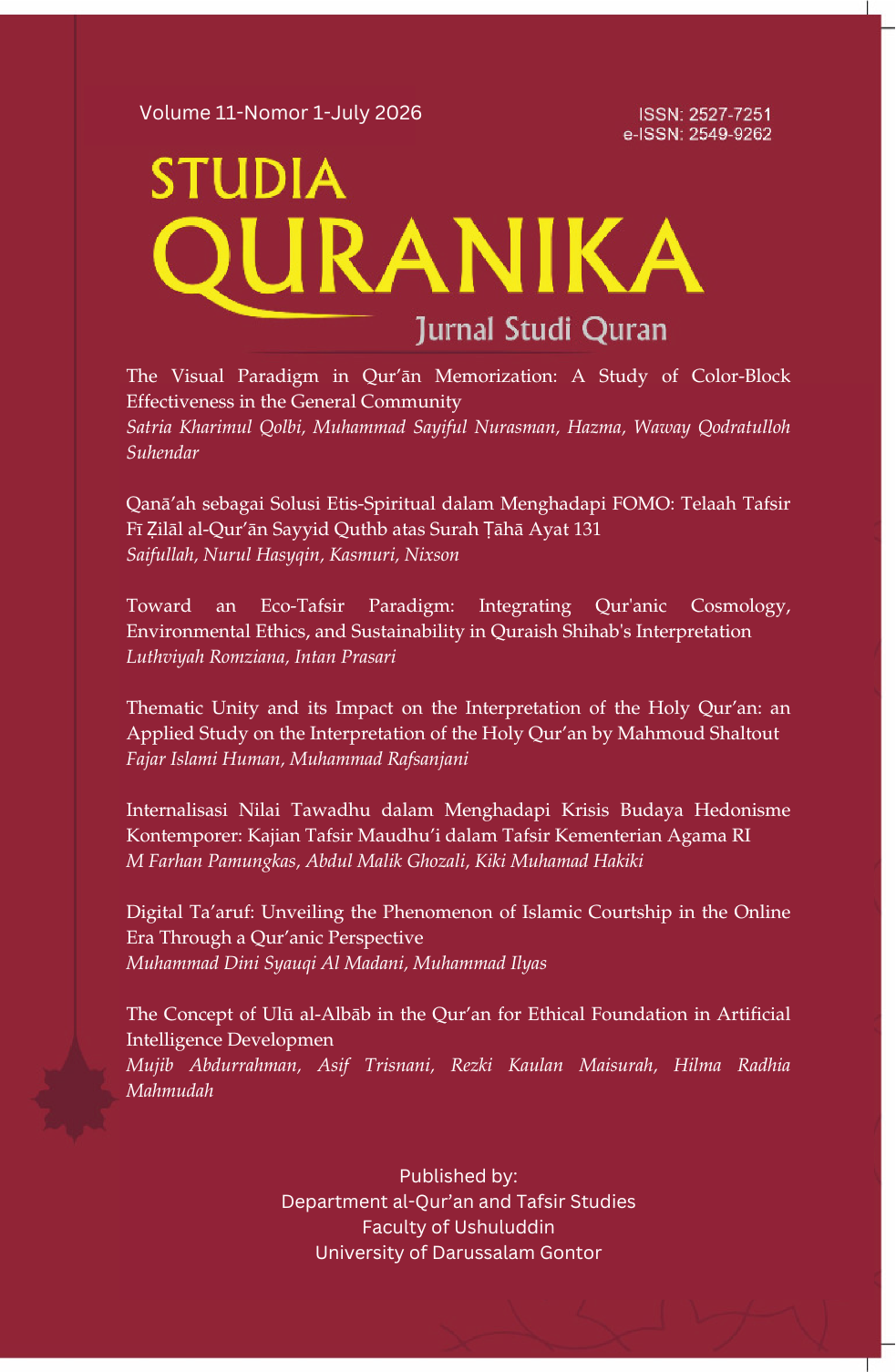
The Visual Paradigm in Qur’ān Memorization: A Study of Color-Block Effectiveness in the General Community
DOI:
https://doi.org/10.21111/studiaquranika.v11i1.4الكلمات المفتاحية:
hafalan Al-Qur’an، blok warna، paradigma visual، tahfiz، Qur’ān memorization، color blocks، visual paradigmالملخص
This study investigates the effectiveness of the color-block method in Qur'ān memorization from the perspective of the general community, focusing on sustaining long-term retention and reducing forgetfulness among memorizers of diverse ages, professions, and educational backgrounds. A descriptive quantitative design was employed, involving 17 purposively selected participants. Data were collected through participant observation, semi-structured interviews, and a Likert-scale questionnaire, then analyzed using SPSS. The findings indicate high acceptance of the color-block method, with item means ranging from 3.94 to 4.47 (aggregate mean = 29.41/35, SD = 4.258). Respondents reported improvements in ease of recall, memorization speed, page differentiation, and concentration, suggesting that color functions as an effective visual cue supporting cognitive processing during tahfīẓ. However, benefits related to spatial recall of verse position were less consistent, reflecting individual differences in learning strategies and spatial memory. Participants also demonstrated strong willingness to adopt and recommend the method, indicating favorable conditions for broader implementation in community-based tahfīẓ settings. The study concludes that the One Day One Color (ODOC) approach represents a practical and innovative learning aid with implications for mentor training, palette standardization, and curriculum development. Future experimental and longitudinal studies are recommended to validate these descriptive findings using objective measures of memorization performance.
المراجع
Alpizar, David, Olusola O. Adesope, and Rachel M. Wong. “A Meta-Analysis of Signaling Principle in Multimedia Learning Environments.” Educational Technology Research and Development 68, no. 5 (2020): 2095–119. https://doi.org/10.1007/s11423-020-09748-7.
Arifin, M. Buku Ajar Metodologi Penelitian Pendidikan. Umsida Press, 2018.
Barus, Rahma Safitri, Asnil Aidah Ritonga, and Yahfizham Yahfizham. “The Influence of the Use of Audio Visual Media and the Ability to Read the Qur’an on Tahfidz Learning Outcomes at Integrated Islamic Private Junior High School.” AL-ISHLAH: Jurnal Pendidikan 14, no. 4 (2022): 5129–38. https://doi.org/10.35445/alishlah.v14i4.1128.
Cai, Ping, and Jun Wang. “The Effect of Background Colors of Learning Materials on Memory:Evidence from Chinese Characters.” Preprint, In Review, December 16, 2024. https://doi.org/10.21203/rs.3.rs-5266192/v1.
Cromley, Jennifer G., and Runzhi Chen. “A Meta-Analysis of Richard Mayer’s Multimedia Learning Research: Searching for Boundary Conditions of Design Principles across Multiple Media Types.” Educational Research Review 49 (November 2025): 100730. https://doi.org/10.1016/j.edurev.2025.100730.
Daulay, Abdul Sattar, and Safriadi Hasibuan. “Tahfidz Teachers’ Strategies in Improving Quran Memorization.” Darul Ilmi: Jurnal Ilmu Kependidikan Dan Keislaman 12, no. 1 (2024): 1–20. https://doi.org/10.24952/di.v12i1.11281.
De Koning, Björn B., Huib K. Tabbers, Remy M. J. P. Rikers, and Fred Paas. “Towards a Framework for Attention Cueing in Instructional Animations: Guidelines for Research and Design.” Educational Psychology Review 21, no. 2 (2009): 113–40. https://doi.org/10.1007/s10648-009-9098-7.
Dzulkifli, Mariam Adawiah, and Muhammad Faiz Mustafar. “The Influence of Colour on Memory Performance: A Review.” The Malaysian Journal of Medical Sciences: MJMS 20, no. 2 (2013): 3–9.
Faqihuddin, Achmad, Mokh Iman Firmansyah, and Abdillah Muflih. “Multisensory Approach in Memorizing the Al-Quran for Early Childhood: Integration of the Tradition of Memorizing the Al-Quran with Digital Technology.” AL-ISHLAH: Jurnal Pendidikan 16, no. 2 (2024): 1289–302. https://doi.org/10.35445/alishlah.v16i2.5326.
Farouq, Muhammad Ayyinna Yusron. “STRATEGI DAN MOTIVASI MAHASISWA PENGHAFAL AL-QUR’AN DI PONDOK PESANTREN TAHFIZUL AL-QUR’AN NURUL FURQON MALANG.” Jurnal Studi Agama Dan Masyarakat 19, no. 1 (2023): 68–77. https://doi.org/10.23971/jsam.v19i1.4564.
Hermawan, S, and W Hariyanto. Buku Ajar Metode Penelitian Bisnis (Kuantitatif Dan Kualitatif ). Umsida Press, 2022.
Khan, Jahangeer, and Chengyu Liu. “The Impact of Colors on Human Memory in Learning English Collocations: Evidence from South Asian Tertiary ESL Students.” Asian-Pacific Journal of Second and Foreign Language Education 5, no. 1 (2020): 17. https://doi.org/10.1186/s40862-020-00098-8.
Lucic, Michelle Emily, and Patricia R Talarczyk. “The Integration of Color and the Retention of Text.” Journal of Student Research 7, no. 2 (2019). https://doi.org/10.47611/jsrhs.v7i2.473.
Mautone, Patricia D., and Richard E. Mayer. “Signaling as a Cognitive Guide in Multimedia Learning.” Journal of Educational Psychology 93, no. 2 (2001): 377–89. https://doi.org/10.1037/0022-0663.93.2.377.
Mayer, Richard. Multimedia Learning. 3rd ed. Cambridge University Press, 2020. https://doi.org/10.1017/9781316941355.
Meusel, Felicia, Nadine Scheller, Günter Daniel Rey, and Sascha Schneider. “The Influence of Content-Relevant Background Color as a Retrieval Cue on Learning with Multimedia.” Education and Information Technologies, ahead of print, February 7, 2024. https://doi.org/10.1007/s10639-024-12460-1.
Ozcelik, Erol, Turkan Karakus, Engin Kursun, and Kursat Cagiltay. “An Eye-Tracking Study of How Color Coding Affects Multimedia Learning.” Computers & Education 53, no. 2 (2009): 445–53. https://doi.org/10.1016/j.compedu.2009.03.002.
Panadero, Ernesto, Anders Jonsson, and Juan Botella. “Effects of Self-Assessment on Self-Regulated Learning and Self-Efficacy: Four Meta-Analyses.” Educational Research Review 22 (November 2017): 74–98. https://doi.org/10.1016/j.edurev.2017.08.004.
Purg Suljič, Nina, Aleksij Kraljič, Masih Rahmati, et al. “Individual Differences in Spatial Working Memory Strategies Differentially Reflected in the Engagement of Control and Default Brain Networks.” Cerebral Cortex 34, no. 8 (2024): bhae350. https://doi.org/10.1093/cercor/bhae350.
Risda, AN. “Implementasi Metode Tahfidzul Qur’an One Day One Colour Dalam Meningkatkan Hafalan Al-Qur’an Peserta Didik Di SD Islam Pangeran Diponegoro Semarang Tahun Ajaran 2024/2025.” Tarbiyah, Universitas Islam Sultan Agung Semarang, 2025.
Rogers, Everett M., Arvind Singhal, and Margaret M. Quinlan. “Diffusion of Innovations 1.” In An Integrated Approach to Communication Theory and Research, 3rd ed., by Don W. Stacks, Michael B. Salwen, and Kristen C. Eichhorn, edited by Don W. Stacks, Michael B. Salwen, and Kristen C. Eichhorn. Routledge, 2019. https://doi.org/10.4324/9780203710753-35.
Sabrina, Vinni, Gifa Oktavia, Albizar Albizar, Hendra Susanti, Fitra Murni Ar, and Yuli Suryani. “Eight Supporting Factors for Students Success in Quran Memorization.” Khalifa: Journal of Islamic Education 6, no. 1 (2022): 73. https://doi.org/10.24036/kjie.v6i1.202.
Sahfitri, Wahyu Dewi, Sumper Mulia Harahap, and Hamdan Hasibuan. “Metode Pembelajaran Tahfīẓ Qur’an Dalam Menguatkan Hafalan Santri Di Pondok Pesantren Al-Ansor Manunggang Julu Kota Padangsidimpuan.” Wahana Didaktika : Jurnal Ilmu Kependidikan 22, no. 1 (2023): 53–65. https://doi.org/10.31851/wahanadidaktika.v22i1.12924.
Saleh, S. Analisis Data Kualitatif. Pustaka Ramadhan, 2017.
Seebauer, Sebastian. “Why Early Adopters Engage in Interpersonal Diffusion of Technological Innovations: An Empirical Study on Electric Bicycles and Electric Scooters.” Transportation Research Part A: Policy and Practice 78 (August 2015): 146–60. https://doi.org/10.1016/j.tra.2015.04.017.
She, Linwei, Zhiguo Wang, Xiaohui Tao, and Liqi Lai. “The Impact of Color Cues on the Learning Performance in Video Lectures.” Behavioral Sciences 14, no. 7 (2024): 560. https://doi.org/10.3390/bs14070560.
Sofiyah, S, and Budianto Budianto. “Eksplorasi Keunikan Siswa Penghafal Al Qur’an Dengan Bantuan Warna Per Baris Dalam Syamil Qur’an.” Ta’lif: Jurnal Pendidikan Dan Agama Islam 1, no. 2 (n.d.): 104–17. https://purpendijournal.com/index.php/talif/article/view/40/12.
Syaifulloh, Muhammad Khafid, Muchtar Hanafi, Tonang Dwi Ardyanto, Nanang Wiyono, Pepi Budianto, and Jumiatmoko Jumiatmoko. “Electroencephalography (EEG) Frontal Alpha Asymmetry Index as an Indicator of Children’s Emotions in the Three Quran Learning Methods: Visual, Auditory, and Memory.” Iranian Journal of Psychiatry, ahead of print, December 20, 2022. https://doi.org/10.18502/ijps.v18i1.11417.
University of Arkansas, Viswanath Venkatesh, James Thong, Hong Kong University of Science and Technology, Xin Xu, and The Hong Kong Polytechnic University. “Unified Theory of Acceptance and Use of Technology: A Synthesis and the Road Ahead.” Journal of the Association for Information Systems 17, no. 5 (2016): 328–76. https://doi.org/10.17705/1jais.00428.
Van Gog, Tamara. “The Signaling (or Cueing) Principle in Multimedia Learning.” In The Cambridge Handbook of Multimedia Learning, 3rd ed., edited by Richard E. Mayer and Logan Fiorella. Cambridge University Press, 2021. https://doi.org/10.1017/9781108894333.022.
التنزيلات
مقدم
##submissions.accepted##
منشور
كيفية الاقتباس
إصدار
القسم
الرخصة
الحقوق الفكرية (c) 2026 Satria Kharimul Qolbi, Muhammad Sayiful Nurasman, Hazma, Waway Qodratulloh Suhendar

هذا العمل مرخص بموجب Creative Commons Attribution-NonCommercial-ShareAlike 4.0 International License.